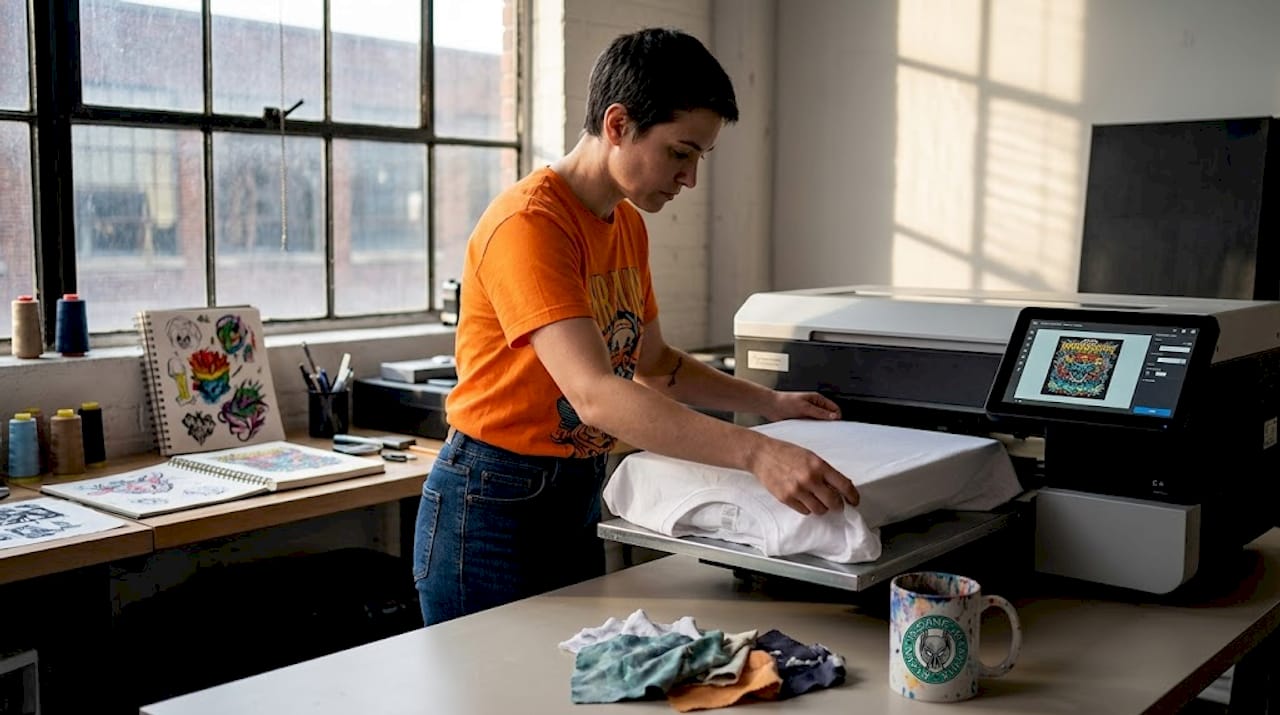
If you’ve ever ordered a custom shirt and wondered how that full-color graphic ended up looking so sharp and feeling so soft, you’ve already encountered what is direct to garment printing. DTG printing is one of the most talked-about methods in custom apparel today, yet it’s frequently confused with screen printing, heat transfers, and direct-to-film technology. This guide breaks down exactly how the process works, where it shines, where it falls short, and how to decide if it’s the right fit for your project.
Table of Contents
- Key takeaways
- What direct to garment printing actually is
- DTG vs. screen printing vs. DTF
- Where DTG printing fits best
- The direct to garment printing process, step by step
- My take on DTG’s place in the market
- Get custom apparel printed right here in the Central Valley
- FAQ
Key takeaways
| Point | Details |
|---|---|
| DTG prints directly onto fabric | Specialized inkjet printers apply water-based inks straight onto garments with no transfer steps. |
| Best for small runs and complex designs | DTG is most cost-effective for low quantities with full-color, detailed artwork on cotton. |
| Process has three core stages | Pretreatment, printing, and curing all affect final print quality and durability. |
| DTG differs meaningfully from screen printing | Screen printing costs less per unit at high volume; DTG wins on flexibility and color detail at low volume. |
| Local DTG services offer real speed advantages | Small batch, same-day customization is a growing competitive edge for local print shops. |
What direct to garment printing actually is
Direct to garment printing, often shortened to DTG, is exactly what it sounds like. A specialized inkjet printer applies ink directly onto the surface of a fabric garment, no intermediate film, no screen, no transfer paper required. The printer works much like a desktop inkjet you might have at home, except it’s built to handle t-shirts, hoodies, and other textiles instead of copy paper.
The technology uses water-based inks applied straight onto fabric, which allows the colors to soak into the fibers rather than sitting on top as a thick layer. The result is a print that feels soft and lightweight, almost as if the design is part of the fabric itself.
Here’s what makes DTG stand out from older methods:
- Full-color capability: You can print photographs, gradients, and complex artwork without any color separation process.
- No minimum orders: One shirt or one hundred, the setup process stays the same.
- Fast turnaround: Without screens or film setups to prepare, orders can move from artwork to finished garment quickly.
- Soft hand feel: Many customers compare DTG print quality to a worn-in, high-quality screen print.
One detail that surprises most people: when printing on dark garments, the printer lays down a white ink base layer first. Think of it as a primer coat. The white ink layer allows full-color inks to sit on top and stay vibrant rather than getting absorbed into and lost in darker fabric fibers.
Pro Tip: If you’re planning a design on a black or navy shirt, always ask your printer to show you a sample print. The white underbase adds slight texture, and seeing it in person helps you make a smarter design decision.
DTG vs. screen printing vs. DTF
Understanding what is direct-to-garment printing gets a lot clearer when you line it up against the alternatives. The three most common methods for custom apparel today are DTG, screen printing, and direct-to-film printing (DTF). Each serves a different purpose.
Screen printing requires a separate physical screen for each color in your design. Setup is time-consuming and costs money upfront, which is why screen printing becomes economical only when you’re ordering in bulk. At 50 or 100 pieces, that setup cost spreads out and the per-unit price drops significantly. At 6 or 12 pieces, it can feel prohibitively expensive.

DTF printing is a newer competitor worth knowing about. DTF uses film transfers that can be applied to almost any fabric type, including polyester and synthetic blends that DTG struggles with. It has no minimum quantities and requires no screens or color separations, making it very flexible.
Here’s a side-by-side comparison to make the choice clearer:
| Factor | DTG | Screen printing | DTF |
|---|---|---|---|
| Setup cost | Very low | High | Very low |
| Minimum order | 1 piece | 12+ pieces typically | 1 piece |
| Best fabric | 100% cotton | Most fabrics | Most fabrics |
| Color complexity | Unlimited colors | Limited (cost rises per color) | Unlimited colors |
| Durability | Good with proper care | Excellent | Very good |
| Cost per unit (large runs) | Higher | Lower | Moderate |
| Turnaround speed | Fast | Slower (setup time) | Fast |
The honest takeaway? DTG wins for small orders with photographic or multi-color designs on cotton. Screen printing wins when you’re ordering large quantities of a simple logo. DTF splits the difference and excels on synthetic fabrics.
- Choose DTG when you need a few shirts with a detailed, full-color design on cotton.
- Choose screen printing when you’re ordering 50 or more pieces of a two or three color design.
- Choose DTF when your fabric is polyester, performance wear, or a synthetic blend.
Where DTG printing fits best
Knowing how does garment printing work is one thing. Knowing when to use it is what actually helps your project succeed. DTG printing is not a universal solution, but in the right context, it’s hard to beat.
The technology performs best on 100% cotton or high-cotton blend fabrics. Cotton fibers absorb the water-based inks well, which produces vivid color and that soft, integrated feel. Polyester and synthetic fabrics repel water-based inks, leading to faded or inconsistent results.
Here are the scenarios where DTG gives you the most value:
- Print-on-demand businesses: If you run an online store and only print when an order comes in, DTG is your method. No inventory. No waste. No minimum commitment.
- Event merchandise: Need 15 shirts for a reunion, 25 for a fundraiser, or 10 for a team? DTG handles small runs without punishing you on price.
- Prototype and sample orders: Designers and brands testing new graphics can print a single sample before committing to a large run.
- Personalized gifts: Individual names, photos, or custom artwork for birthdays, weddings, or corporate gifts translate beautifully through DTG.
- Complex artwork: Photographic images, gradients, and designs with more than four colors are where DTG earns its reputation.
There are real limitations to keep in mind, though. DTG requires more time per shirt compared to screen printing on large runs, because each garment is printed individually. If you need 500 identical shirts quickly, screen printing will almost always cost less and finish faster.
Durability is also worth discussing honestly. DTG prints hold up well with proper washing care, typically cold water and turned inside out, but they may fade faster than screen prints if exposed to repeated high-heat washing or industrial laundering.
Pro Tip: When designing for DTG, use a minimum resolution of 300 DPI and convert your file to the sRGB color profile. Files that look sharp on screen can print differently if they’re low-resolution or in CMYK format, and catching that early saves a reprint.
Check out these t-shirt design tips to make sure your artwork is optimized before it ever reaches the printer.
The direct to garment printing process, step by step
Understanding the direct to garment printing process from start to finish removes a lot of mystery and helps you communicate better with your printer. Here’s how it actually works:
-
Design preparation: Your artwork file is loaded into the printer’s RIP software (Raster Image Processor). This software translates your design into print instructions. Resolution matters here. Low-resolution files produce blurry prints, no matter how good the printer is.
-
Garment selection and placement: The garment is loaded flat onto a printing platen, which holds it taut and positioned correctly under the print head. Wrinkles or loose fabric will cause misalignment, so this step gets more attention than it might seem.
-
Pre-treatment application: For dark garments, a pretreatment solution is sprayed or applied before printing. This chemical bonds ink to fabric and is what makes the white underbase layer adhere properly. Without it, the ink would wash out quickly. Light garments often skip this step.
-
Printing: The printer passes over the garment, laying down the white underbase first on dark fabrics, then printing the full-color design on top. The process is precise and automatic, but each shirt is printed individually.
-
Curing: After printing, the garment goes through a heat curing process, usually in a conveyor dryer or heat press. Curing sets the ink permanently into the fabric. Skipping or rushing this step is one of the most common causes of cracking and premature fading.
-
Quality check and finishing: The finished garment is inspected, folded, and packaged. Good print shops check for color consistency, alignment, and coverage before anything ships or goes out the door.
The whole workflow for a single shirt, design to done, can be completed in under an hour at a well-equipped shop. That speed is exactly why same-day, small-batch customization has become a real competitive advantage for local print businesses.
My take on DTG’s place in the market

I’ve watched DTG printing go from a niche technology to a standard offering at serious print shops, and the shift has been significant. What I find genuinely interesting is that most of the confusion I see isn’t about what DTG is. It’s about when to use it.
People often come in expecting DTG to replace screen printing entirely. It won’t. Screen printing on large runs still delivers lower per-unit cost and exceptional durability for simple designs. But for anything involving gradients, photography, or orders under about 24 pieces, DTG is the smarter call every time.
What I think gets underestimated is the business model DTG enables. Print-on-demand has opened doors for solo creators and small brands that couldn’t afford the minimum orders screen printing traditionally required. Accessible same-day customization at attractive prices is genuinely changing who gets to sell custom apparel, and that matters.
My practical advice for anyone starting out: don’t treat DTG as a budget alternative to screen printing. Treat it as the right tool for the right job. Understand your order sizes, your fabric, and your design complexity before committing to any method. That clarity will save you money and frustration.
— M
Get custom apparel printed right here in the Central Valley

If you’re ready to move from research to results, Pigdesigns is your local answer. Based in Lemoore, California, and proudly serving the Central Valley, Pigdesigns brings DTG-quality printing together with fast turnaround and real human support. Whether you need five shirts for your team, 50 for your next community event, or a single sample for a new brand concept, the team at Pigdesigns delivers without the runaround.
Explore the full range of custom apparel and embroidery services, from printed t-shirts and hoodies to embroidered hats and jackets. Every order benefits from local production, which means faster communication, quicker delivery, and quality you can check in person.
Voted the best print shop in Kings County, Pigdesigns has built its reputation on exactly the kind of service larger national platforms can’t offer. Quick turnaround. Great prices. Amazing quality. See everything available and start your order today or stop in and talk through your project with someone who knows printing inside and out.
FAQ
What is direct to garment printing in simple terms?
DTG printing is a process where specialized inkjet printers apply water-based inks directly onto a fabric garment, producing full-color, high-resolution designs with a soft feel and no minimum order requirements.
How durable are DTG prints compared to screen prints?
DTG prints hold up well with proper care, including cold-water washing and turning garments inside out, but screen prints on large runs tend to have a longer lifespan under repeated high-heat or industrial washing conditions.
What fabrics work best for DTG printing?
DTG printing performs best on 100% cotton or high-cotton blend fabrics, since cotton fibers absorb water-based inks effectively. Polyester and synthetic materials generally produce inconsistent results with DTG.
Is DTG printing good for small orders?
Yes. DTG printing is one of the most cost-effective options for small runs because it requires no screens, no setup fees, and no minimum quantities, making single-piece orders fully practical.
How does DTG printing differ from DTF printing?
DTG prints directly onto the garment using water-based inks, while DTF prints onto a film transfer that is then heat-applied to the fabric. DTF works on a wider range of fabric types, including synthetics, while DTG typically produces a softer feel on cotton garments.
Leave a Reply