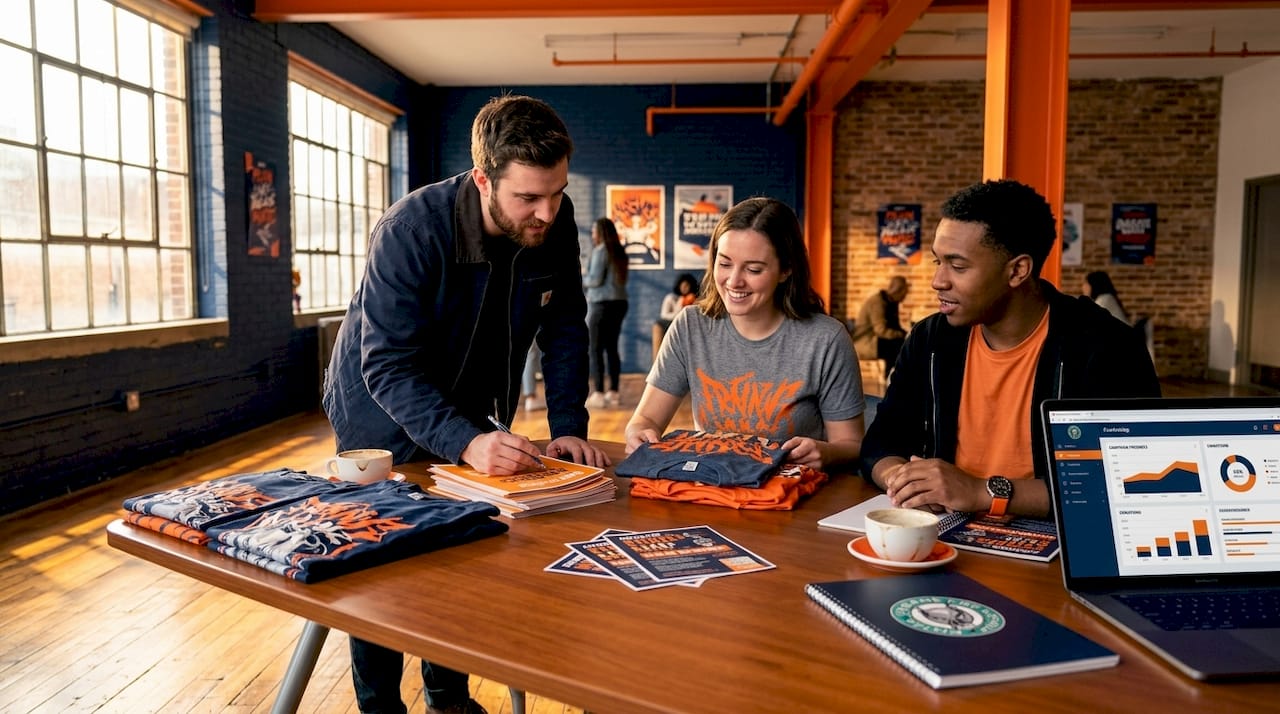
Bake sales run out. Car washes depend on weather. And raffle tickets pile up unsold in someone’s glove compartment. If your school, sports team, or nonprofit in the Central Valley has hit that wall, t-shirt fundraising offers something different. It turns every supporter into a walking advertisement for your cause, and custom apparel is a low-risk, high-reward fundraising strategy that supporters actually enjoy. This guide walks you through planning, designing, executing, and verifying a t-shirt campaign that raises real money for your community.
Table of Contents
- Preparing for your t-shirt fundraiser
- Designing and planning your t-shirt campaign
- Executing and promoting your t-shirt fundraising campaign
- Verifying success and ensuring compliance in your fundraiser
- Why pairing sales with donation options is a game changer for your fundraiser
- Local custom printing and signage solutions to power your Central Valley fundraiser
- Frequently asked questions
Key Takeaways
| Point | Details |
|---|---|
| T-shirt fundraising benefits | Selling custom shirts engages communities and raises funds effectively for local causes. |
| Pair sales with donations | Combining apparel sales with a donation page captures contributions from supporters who don’t buy merchandise. |
| Design for success | Simple, well-placed designs reduce production issues and appeal widely to supporters. |
| Comply with IRS rules | Clearly disclose the value of goods received to donors to ensure proper tax receipt compliance. |
| Local print partners | Using local custom printers streamlines production and supports Central Valley fundraisers efficiently. |
Preparing for your t-shirt fundraiser
With a clear understanding of the benefits of t-shirt fundraising, the real work starts with smart preparation. Skipping this step is where most campaigns quietly fall apart before a single shirt is sold.
Define your goal first
Before you talk to a printer or sketch a logo, get specific about what you need. Are you raising $2,000 for new band uniforms? $5,000 for a youth sports league? Knowing your target shapes every decision that follows, from how many shirts to order to what price point makes sense.
Here is what to nail down before anything else:
- Your financial goal: Total funds needed, including production costs
- Your audience: Students, parents, local businesses, or the broader Central Valley community
- Your timeline: Event date, ordering deadline, and production lead time
- Your selling model: Pre-orders only, bulk orders, or an ongoing online store
Choose your selling model
You have two main options. The first is a pre-order model, where supporters commit to buying before you place a bulk print order. This reduces financial risk because you only print what is already sold. The second is a bulk order model, where you print upfront and sell from inventory. This works well for organizations with an established audience, like a school with 400 students.
A numbered checklist for your pre-campaign phase:
- Set a firm fundraising dollar target
- Estimate your cost per shirt based on expected order volume
- Calculate your sale price to cover costs and hit your goal
- Choose a campaign window (two to three weeks works well for most groups)
- Assign a campaign coordinator to handle orders and payments
Understand IRS compliance from the start
This one surprises a lot of organizers. If you sell shirts as part of a nonprofit fundraiser, the transaction is not automatically a tax-deductible donation. When a supporter pays $30 for a shirt worth $15, only the excess amount is deductible and proper IRS disclosures are required. You cannot imply the full purchase price is a charitable gift if goods are exchanged.
| Scenario | Tax treatment |
|---|---|
| Donor pays $30, receives $15 shirt | $15 may be deductible |
| Donor gives $30 with no goods received | Full $30 may be deductible |
| Donor pays $30, no disclosure provided | Compliance risk for the nonprofit |
Pro Tip: Have your treasurer or a tax advisor review your campaign language before you publish it. A simple disclaimer on your order form protects you and builds trust with donors.
For help with designing custom shirts and understanding print timelines, getting familiar with the process early saves headaches later. And if you want to understand what goes into local t-shirt printing, knowing the basics helps you ask the right questions when you contact your printer.
Designing and planning your t-shirt campaign
With your plan and design concepts ready, it is time to make decisions that directly affect cost, quality, and how fast your shirts get into people’s hands.

Placement and print method matter more than you think
Where your design sits on the shirt and how it gets printed affects both your budget and your production timeline. Design placement and print method impact cost, timing, and fundraising success. Simpler, consistent designs reduce delays significantly.
Common placements:
- Full front chest: High visibility, standard cost, works for most designs
- Left chest: Clean and professional, great for logos
- Full back: Ideal for listing sponsors, team names, or event details
- Sleeve: Adds a premium feel, best as a secondary element
Print method comparison:
| Method | Best for | Cost range | Detail level |
|---|---|---|---|
| Screen printing | Large bulk orders, simple designs | Low per unit | Moderate |
| Direct to garment (DTG) | Small runs, complex or photo-based art | Higher per unit | High |
| Embroidery | Hats, polos, premium feel | Moderate to high | Limited |
For most charity t-shirt campaigns at the school or community level, screen printing on a front chest or full front placement hits the sweet spot of cost and impact.
Keep your design simple and strategic
You do not need a complicated design to sell shirts. You need a design that people are proud to wear around Fresno, Visalia, or Hanford. A strong cause-driven message with clean typography often outperforms a busy graphic.
- Limit your design to two or three colors to keep screen printing costs down
- Use high-contrast colors so the design reads clearly at a distance
- Include your organization name and the year or event for long-term appeal
- Avoid very thin lines or tiny text that can bleed or fade in printing
Pro Tip: Run a community design contest. Invite students, fans, or members to submit concepts. You get free design ideas, and the winner becomes a built-in ambassador who tells everyone they helped design the shirt.
Explore t-shirt design tips to understand what translates well from screen to fabric. And consider how using personalized merchandise can strengthen your organization’s identity beyond the fundraiser itself.
Executing and promoting your t-shirt fundraising campaign
Now that your campaign is live, keeping the momentum going requires consistent promotion and smart order management.

Launch your campaign with clear structure
Confusion kills sales. Make sure every supporter knows exactly what they need to do.
- Create a simple order form (Google Forms works great) with size options and payment instructions
- Set a firm order deadline and display it everywhere
- Communicate pickup or delivery logistics before orders close
- Designate one person to answer questions and confirm orders
Pair shirt sales with a donation page
This is where most fundraisers leave money on the table. Not everyone wants a shirt. Maybe a grandparent wants to support but does not need another tee. Maybe a local business wants to contribute more than the cost of a shirt. Pairing shirt sales with a crowdfunding page captures donations from supporters who prefer giving directly over receiving merchandise.
A well-structured donation funnel guides supporters to the right giving option based on their preference, which increases total funds raised without any extra printing cost.
“The best t-shirt fundraisers treat the shirt as a conversation starter, not the only way to give.”
Promotion channels to use:
- Social media posts with countdown timers to the order deadline
- Email blasts to your existing contact list with a direct link to the order form
- Flyers at local businesses, schools, or community centers in the Central Valley
- Announcements at games, meetings, or community events
- Clear messaging that says “Can’t get a shirt? You can still donate here” with the link
This dual approach to elevating your event branding while keeping non-buyers engaged is what separates campaigns that hit $3,000 from ones that barely reach $800. You can also boost your brand with merchandise by giving top donors or volunteers a shirt as a thank-you, adding perceived value to the campaign.
Pro Tip: Post a photo update halfway through your campaign showing how many shirts have been ordered and how close you are to your goal. Progress visibility drives urgency and last-minute orders.
Verifying success and ensuring compliance in your fundraiser
With these execution steps in motion, the final piece is making sure everything is documented correctly and your organization stays on the right side of tax law.
Track every transaction separately
This is especially important for nonprofits. You need a clear record of what came in as a shirt purchase versus what came in as a straight donation. The two are treated differently for tax purposes, and mixing them up causes real problems at year-end.
- Record each shirt sale with the buyer’s name, size, amount paid, and fair market value of the shirt
- Record each direct donation separately with donor name, amount, and date
- Note whether any goods or services were provided to the donor
Issue receipts and acknowledgments correctly
Nonprofits must provide clear written disclosures for quid pro quo contributions, which is the technical term for situations where a supporter gives money and receives something in return, like a t-shirt. If a donor gives more than $75 in a transaction that includes goods, a written disclosure is required.
| Transaction type | Receipt required | Deductible amount |
|---|---|---|
| Shirt purchase only | Recommended | Amount over fair market value |
| Pure donation (no goods) | Required over $250 | Full amount |
| Combo purchase plus donation | Required if over $75 total | Donation portion only |
“A clear paper trail protects your nonprofit’s tax status and builds long-term donor trust.”
Pro Tip: Use a simple spreadsheet template from the start of your campaign. Trying to reconstruct records after the fact is painful and error-prone.
After your campaign closes, gather feedback from your team and your buyers. What confused people? Where did orders get delayed? Did your design resonate? This data is gold for your next campaign. For a deeper look at compliance considerations specific to printed apparel, the t-shirt printing compliance process is worth reviewing before you finalize your next order.
Why pairing sales with donation options is a game changer for your fundraiser
Here is an opinion that might surprise you: the shirt is not your fundraiser. The shirt is your marketing tool. The fundraiser is the community support you build around it.
Most nonprofit apparel fundraising campaigns focus entirely on moving shirts. That mindset leaves a portion of your potential supporters behind. Some people genuinely do not want more clothing. Some live on fixed incomes and cannot justify the price. Some simply prefer giving cash. When you only offer shirts, those supporters feel excluded from participating in something meaningful.
Adding a donation page alongside shirt sales addresses the misconception that if supporters don’t buy merch, they don’t support the cause. That framing shift alone can change how your entire community responds to your campaign.
We have seen this play out in Central Valley communities time and again. A school booster club runs a shirt campaign, hits 60 percent of their goal from shirt sales, then adds a donation link with the message “Missed the shirt order? You can still help us cross the finish line.” They close the gap in 48 hours. The shirt created visibility and emotional connection. The donation page captured the rest.
The other thing worth saying plainly: people who boost their brand with merchandise understand that apparel is about identity, not just revenue. When your supporters wear your shirt to the Hanford Harvest Festival or out on 10th Avenue, they are telling the story of your cause without saying a word. That visibility feeds future fundraising. Think beyond the single campaign.
Local custom printing and signage solutions to power your Central Valley fundraiser
Running a successful t-shirt fundraiser in the Central Valley means finding a printer who understands your timeline, your budget, and the stakes of getting it right the first time.

At Plain Insane Graphix in Lemoore, we have been serving schools, sports teams, nonprofits, and local businesses across Kings County and the greater Central Valley for years. We are voted the best print shop in Kings County, and we back that up with quick turnaround times, competitive pricing, and quality that holds up wash after wash. Whether you need screen-printed tees for 150 students or embroidered polo shirts for your board members, we handle it all under one roof. Our custom embroidery services and printed t-shirts and banners make coordinating your fundraiser apparel simple. Visit Plain Insane Graphix to get started or stop by and talk to our team in person.
Frequently asked questions
Can supporters donate without buying a t-shirt?
Yes, pairing shirt sales with a donation page lets supporters contribute financially even if they do not want merchandise, which increases your total funds raised.
Are t-shirt purchases considered charitable donations for tax purposes?
Not entirely. Only the excess over the shirt’s fair market value is potentially tax-deductible, and your nonprofit must provide proper written disclosures to remain compliant.
How can I ensure my t-shirt design doesn’t delay production?
Keep your design simple. Fewer colors and clear boundaries prevent last-minute artwork revisions that push back your print timeline, which is especially critical if you have an event deadline.
What’s the best way to promote my t-shirt fundraiser locally?
Use a combination of social media countdowns, community emails, flyers at local gathering spots, and in-person announcements to reach the widest audience. Always include a direct link to both your order form and your donation page so every type of supporter has an easy way to help.
Leave a Reply