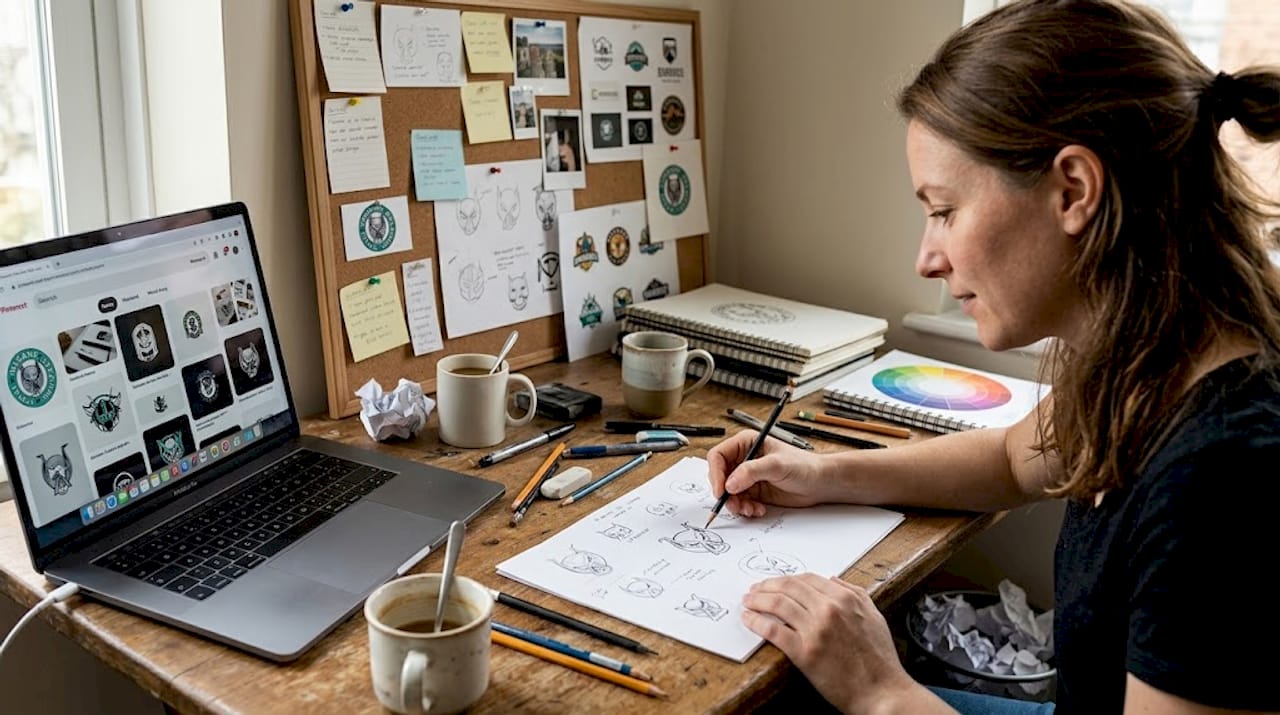
Your logo is not just a picture. It is the first thing a potential customer sees on your storefront banner, your staff t-shirts, your work truck, and your social media page. For small businesses and organizations across the Central Valley, a strong logo can be the difference between someone stopping in or driving past. Small business logos shape revenue, reputation, and trust by working consistently across signage, apparel, and every other touchpoint where your brand shows up. This guide walks you through what logo design really means, how the process works, and how to make sure your logo performs everywhere you need it.
Table of Contents
- Defining logo design: More than just a pretty picture
- How effective logo design works: Science-backed principles
- The standard logo design process: From concept to brand asset
- Logo versatility: Making your design work everywhere
- The rise of AI in logo design: What you need to know
- The real differentiator: Why intentional logo design unlocks local success
- Ready to take your brand further with custom logo design?
- Frequently asked questions
Key Takeaways
| Point | Details |
|---|---|
| Logos are strategic assets | A good logo shapes how customers recognize and trust your brand across every platform. |
| Evidence-based design pays off | Logos built on scientific principles and real data outperform generic marks in memorability and versatility. |
| The process is collaborative | Effective logo design follows a step-by-step process, ensuring brand fit and readiness for all uses. |
| Versatility is essential | A strong logo should look perfect on shirts, signs, vehicles, and online—choose vector formats. |
| New tech presents options | AI can help with quick concepts, but custom design leads to better brand results for most local organizations. |
Defining logo design: More than just a pretty picture
A lot of business owners think of a logo as something you need to “get done” before you can print your shirts or put up your sign. That mindset is understandable, but it leads to shortcuts that cost you later. Logo design is the deliberate process of creating a visual symbol, wordmark, or icon that communicates who you are, what you do, and why people should trust you. Done right, it becomes the foundation of your entire brand identity.
Think about a local ag supply company in Hanford or a youth soccer league in Visalia. Every time those organizations put their logo on a jersey, a banner, or a vehicle, they are either building recognition or creating confusion. A well-designed logo builds recognition. A rushed or generic one creates confusion, and confused customers do not convert.
Here are the most common misconceptions we hear from local businesses:
- “Any graphic will do.” Not true. A generic clip-art logo looks unprofessional on a vinyl banner and nearly invisible when embroidered on a hat.
- “I can use a free online logo maker.” These tools produce cookie-cutter designs that dozens of other businesses already use, which destroys your originality.
- “My logo only needs to look good on my website.” Your logo needs to scale from a business card to a 10-foot banner without losing clarity.
- “Logo design is too expensive for a small org.” A poorly designed logo costs far more in reprints, rebranding, and lost credibility.
The core principles of effective logo design include simplicity, memorability, versatility, scalability, relevance, timelessness, originality, and balance. Each of these principles is non-negotiable if you want a logo that works for every application your organization needs.
“A logo that only works in one format is not a logo. It is a liability. If your design falls apart when you scale it up for a banner or shrinks to a blur on a hat, you are starting every customer interaction at a disadvantage.”
Simplicity matters because complex logos lose detail when reduced to small sizes. Scalability matters because your logo will appear at vastly different dimensions across media. Relevance matters because your logo should reflect your industry and community, not just look trendy. These principles are not suggestions. They are the standard for logos that actually work.

How effective logo design works: Science-backed principles
Not all logos are created equal, and the difference between a forgettable design and one that sticks in people’s minds is not just artistic preference. There is real data behind what makes logos perform.
Empirical data on logo distinctiveness shows that literal brand name logos score 56 points higher in distinctiveness compared to abstract marks. Asymmetrical designs score 18 points higher than symmetrical ones, even though 92% of logos use symmetry. Logos that include devices, icons, or characters outperform those using script-only designs, which score 46 points lower in distinctiveness.
What does this mean for your business? It means that if your logo is just a script font with your company name, you are already at a disadvantage in a crowded market.
| Logo feature | Impact on distinctiveness |
|---|---|
| Literal brand name included | +56 points |
| Asymmetrical design | +18 points over symmetrical |
| Icon or character element | Positive boost |
| Script-only design | -46 points |
| Symmetrical layout | Lower than asymmetrical |
Beyond distinctiveness, dynamic icons outperform static designs in attention retention. One neuroscientific study found that a dynamic logo design achieved 107% end-attention retention compared to lower scores for static alternatives. High cognitive engagement with a logo correlates directly with stronger brand memory.
This is especially relevant for Central Valley businesses that need their brand to stand out at busy events, on vehicle wraps rolling down Highway 198, or on Coalinga sign and t-shirt printing orders where visibility is everything.
Pro Tip: Match your logo’s complexity to the media where it will appear most. A detailed icon might look great on a website header but could lose definition when embroidered on a polo shirt. Always test your logo at small sizes before finalizing.
The takeaway here is clear. Investing in a logo that follows these proven principles is not a luxury. It is a smart business decision backed by science.
The standard logo design process: From concept to brand asset
Understanding why some logos work sets the stage for following an effective design process. Knowing what to expect from a professional designer also helps you ask better questions and get better results.
The standard logo design process follows these key steps:
- Research and brief. The designer studies your brand, your target audience, and your competitors. This step ensures the logo reflects your actual business, not just a generic idea of it.
- Brainstorm and sketch concepts. Ideas are explored on paper before any digital work begins. This phase generates variety and prevents the designer from locking into the first idea.
- Digital refinement and variations. The strongest concepts are developed digitally, with multiple variations in layout, proportion, and style.
- Select fonts and colors. Typography and color palette are chosen to reinforce your brand personality and ensure readability across all media.
- Feedback and testing. You review the designs, provide input, and the designer refines based on your feedback. Testing across different backgrounds and sizes happens here.
- Final assets in multiple formats. You receive your logo in vector formats (AI, EPS, SVG) as well as raster formats (PNG, JPG) for digital use, with color and black-and-white variations.
Each of these steps matters. Skipping the research phase leads to logos that look nice but do not connect with your audience. Skipping the testing phase leads to logos that fall apart in production.
The final delivery step is critical for local organizations. When you order custom t-shirt printing for your team or custom embroidery for local logos on staff uniforms, your printer needs clean vector files. Without them, the production quality suffers, and your brand looks unprofessional.
Pro Tip: Always ask your designer for your logo in vector format (AI or EPS file) and request both full-color and single-color versions. Single-color versions are essential for embroidery and one-color printing jobs.
Personalized merchandise is one of the most powerful branding tools available to local organizations, but it only works well when the logo behind it is built for production from the start.
Logo versatility: Making your design work everywhere
After learning the process, the next step is ensuring your logo works for everything your organization needs. Versatility is not an afterthought. It is a design requirement.

Vector artwork is the non-negotiable foundation of a versatile logo. Vector files use mathematical paths to define shapes, which means they can be scaled to any size without losing sharpness. A raster image (like a JPEG or PNG) is built from pixels, and when you scale it up, those pixels become visible and the image looks blurry or blocky.
Here is how the two formats compare across common uses:
| Media type | Raster (JPEG/PNG) | Vector (AI/EPS/SVG) |
|---|---|---|
| Large banners and signage | Blurry at large sizes | Sharp at any size |
| Vehicle wraps and decals | Loses quality when enlarged | Perfect for large-format printing |
| Embroidery on apparel | Cannot be used directly | Converts cleanly to stitch files |
| Social media and web | Works well at small sizes | Works at all sizes |
| Business cards | Acceptable at small sizes | Preferred for crisp output |
Custom vector logos are essential for local organizations that need their brand to appear on farm stand signage, event banners, work trucks, and team apparel. A single well-built vector logo file handles all of those applications without any quality loss.
Here is a quick checklist to make sure your logo is ready for every use:
- Does it work in black and white? Some applications, like embroidery or single-color printing, require it.
- Is it readable at small sizes? Test it at one inch wide. Can you still read the name?
- Does it work on dark and light backgrounds? You need reversed versions for dark shirts and banners.
- Is it saved as a vector file? If your designer only gave you a JPEG, ask for the source file.
- Are fonts outlined? Outlined fonts prevent issues when the file is opened on a different computer.
Central Valley branding demands versatility because local businesses show up everywhere, from Fresno trade shows to Lemoore community events to Kings County fair booths. Your logo needs to perform in all of those environments.
The rise of AI in logo design: What you need to know
Before you choose a route for your logo, it is worth understanding how AI-powered logo tools fit into the picture. These platforms have grown quickly, and they do offer some real advantages for certain situations.
AI-generated logo concepts score comparably or even higher than manually designed concepts in initial presentation quality, with mean scores around 2.9 versus 2.6 for manual designs. That sounds promising, but the data tells only part of the story.
| Factor | AI logo tools | Custom human design |
|---|---|---|
| Cost | Very low to free | Moderate to higher investment |
| Speed | Minutes | Days to weeks |
| Originality | Generic, widely reused | Unique to your brand |
| Brand fit | Limited customization | Built around your specific needs |
| File formats | Often raster only | Full vector package available |
| Production-ready | Rarely | Yes, when done professionally |
Here is the honest truth about AI logo tools for local businesses:
- They are fast and cheap, which is appealing when you are on a tight deadline or budget.
- They produce generic results because they pull from existing design patterns.
- Most AI tools do not deliver true vector files, which means you will run into production problems when you try to print a banner or embroider a hat.
- They cannot account for your specific community, your industry nuances in the Central Valley, or the way your brand needs to look on a work truck versus a youth league jersey.
For a one-time event flyer or a temporary social media post, an AI tool might get the job done. But for a logo that will represent your business on signage, vehicles, apparel, and promotional products for years to come, custom human design is the right investment. The production limitations of AI-generated logos alone make them a poor choice for any organization that needs physical branded materials.
The real differentiator: Why intentional logo design unlocks local success
Here is something most logo articles will not tell you. The biggest mistake local organizations make is not choosing the wrong font or the wrong color. It is treating logo design as a checkbox rather than a strategy.
We have seen it happen many times here in the Central Valley. A business rushes through a logo to get their shirts printed before a big event. Two years later, they are reprinting everything because the logo does not scale, the file is a low-resolution JPEG, and the design looks dated. That rebranding cost is always higher than doing it right the first time.
The organizations that build lasting recognition in Kings County and beyond are the ones that invest in a deliberate logo from the start. When your logo looks sharp on your work truck rolling through Lemoore, matches exactly on your team hoodies, and holds up on a 20-foot banner at a community event, people notice. That consistency builds trust faster than any ad campaign.
The temptation to cut corners is real, especially for nonprofits, youth leagues, and small businesses watching every dollar. But a well-built logo pays for itself through reduced production headaches, stronger brand recognition, and the credibility that comes from looking professional at every touchpoint. Invest once. Do it right. Your brand will thank you every time it shows up in the community.
Ready to take your brand further with custom logo design?
If this guide has shown you anything, it is that a strong logo is the foundation everything else is built on. Every shirt, sign, decal, and promotional product you put into the world is only as powerful as the logo on it.

At Plain Insane Graphix, we have spent over 20 years helping Central Valley businesses build brands that work everywhere. From custom logo solutions to custom branded apparel like t-shirts, hoodies, and embroidered hats, we handle the full picture. Our team understands what it takes to produce a logo that looks great on a yard sign in Hanford and a hoodie in Fresno. If you are ready to build a brand that turns heads and builds trust, connect with our Central Valley branding experts and let’s get started.
Frequently asked questions
What is the main purpose of a logo?
A logo is a visual symbol that represents your brand, making it instantly recognizable and reinforcing trust with customers. As the visual identity of a brand, it serves as the anchor for all your marketing and promotional materials.
How long does it take to design a logo?
A professional logo design process usually takes from a few days to a few weeks, depending on revisions and requirements. The multiple steps from research to final assets ensure the final product is built for long-term use across all media.
Can I use my logo on shirts, signs, and online?
Yes, a well-designed logo, especially in vector format, can be used across apparel, signage, vehicles, and digital media. Vector logos are essential for versatility because they scale without losing quality in any of those applications.
Are AI-created logos as good as custom designs?
AI logos are quick and budget-friendly but often lack the brand alignment and originality of custom human-designed logos. While AI-generated concepts score comparably in initial presentation, they typically fall short in production readiness, file format quality, and long-term brand fit.
Leave a Reply